PNM Northeast Albuquerque Substation and Transmission Line Proposal
Current status: Bernalillo County denied PNM’s application on May 12, 2026. PNM has appealed that decision to the New Mexico Second Judicial District Court.
Official information: PNM: Protect the Grid | PNM Project Page | PNM Conservation Request
Media coverage: KRQE | Albuquerque Journal | KOAT | City Desk ABQ
Join the discussion: PNM Community Updates Google Group
Current Grid Conditions and PNM’s Position
PNM is currently asking customers in far Northeast Albuquerque to voluntarily conserve electricity between 4:00 and 9:00 p.m. during periods of high summer demand. PNM has also advised residents to prepare for possible outages, including planning for medical needs and maintaining an emergency preparedness kit.
On its new Protect the Grid webpage, PNM states that electrical demand in far Northeast Albuquerque has continued to grow while attempts to secure approval for a new substation have been denied. PNM says additional infrastructure is needed to increase capacity, improve reliability during periods of high demand, reduce the risk of outages, and support future growth.
SHHA does not dispute the need for reliable electric service or the possibility that Northeast Albuquerque requires additional electrical infrastructure. The dispute concerns whether PNM adequately justified the location, size, transmission route, planning assumptions, and alternatives included in the denied application.
Why SHHA Appealed the Project Approval
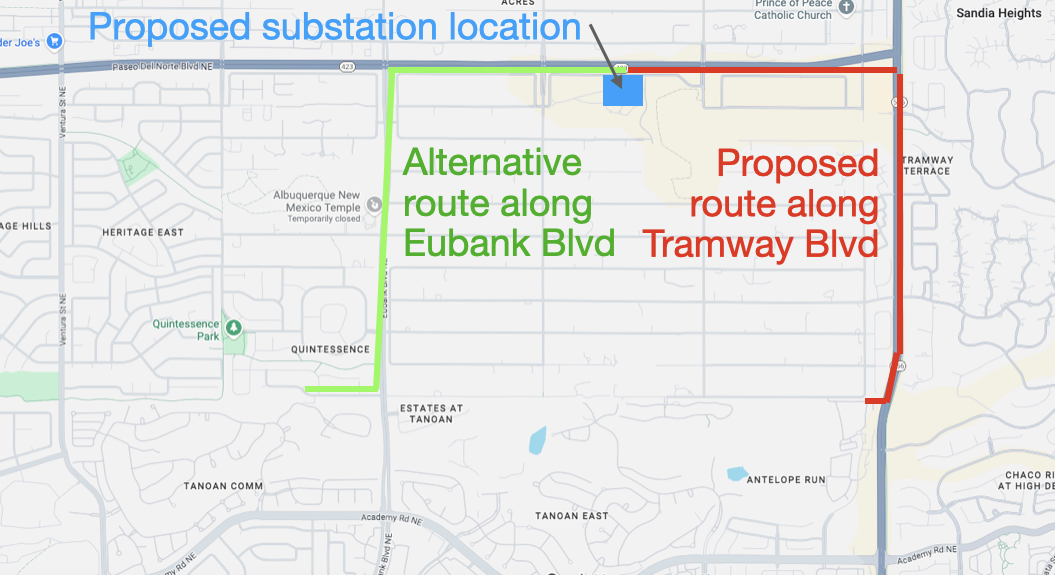
PNM proposed a new electrical substation on Paseo del Norte between Eubank Boulevard and Browning Street, together with 115 kV transmission lines on towers extending east along Paseo del Norte and then south along Tramway Boulevard.
The proposed transmission corridor would place high-voltage lines along the Tramway recreational trail and within approximately 100 feet of at least 37 Sandia Heights homes. Residents raised concerns about wildfire risk, evacuation, visual impacts, property values, and possible effects on the availability and cost of homeowners’ insurance.
SHHA’s appeal also questioned whether PNM’s application adequately demonstrated that this specific site and transmission route were the most appropriate way to address the identified electrical need.
The proposed substation would have had a capacity of 66 MVA, compared with approximately 22.4 MVA for several other substations serving the area. SHHA and the other appellants argued that PNM did not provide sufficient load data, growth projections, siting studies, or analysis of alternatives to justify placing a facility of that scale in a residentially zoned area.
Sandia Heights has been more than 95% built out for many years. The appellants therefore asked PNM to more clearly identify the geographic area driving the projected demand and to evaluate locations closer to areas experiencing greater development.
County Commissioners’ Decision
On May 12, 2026, the Bernalillo County Board of County Commissioners granted the community appeals and denied PNM’s applications for the proposed substation and transmission-line project.
The appeals included those filed by the Sandia Heights Homeowners Association, North Albuquerque Acres resident and attorney Robert Dale Morrison, and the North Albuquerque Acres Residents’ Coalition.
The decision followed months of written comments, testimony, technical analysis, public hearings, and participation by residents of Sandia Heights and North Albuquerque Acres.
PNM’s Court Appeal
On June 15, 2026, PNM filed a notice of appeal in the New Mexico Second Judicial District Court challenging the County Commission’s final decisions.
The named parties responding to the appeal include the Bernalillo County Board of County Commissioners and the three community appellants: SHHA, Robert Dale Morrison, and the North Albuquerque Acres Residents’ Coalition.
The court proceeding concerns whether the County Commission’s decision should be upheld. It is not a new public hearing on PNM’s application. SHHA is coordinating with legal counsel, Bernalillo County, and the other appellees as the case proceeds.
Latest Update on PNM Appeal with NM Second Judicial Court
We were notified today that PNM has requested a 45-day extension to file their Statement of Appellate issues due to their law firm having a virus problem. We anticipate the judge will approve. We anticipate the PNM Statement of Appellate to be filed sometime toward the end of September.
SHHA Board and Task Group Actions
On June 29, 2026, the SHHA Board approved hiring attorney Michael Cadigan to represent SHHA in the court appeal. Cadigan has represented the North Albuquerque Acres Residents’ Coalition in this matter since fall 2025 and will represent both organizations.
The Board also confirmed President Robin Dozier Otten’s appointment of Kindred Murillo as chair of the PNM Special Task Group.
SHHA thanks Mark Humphrey for chairing the Task Group through the County proceedings and helping guide the successful community appeal. The work of the Task Group, the Technical Working Group, the Tenacious Team, and hundreds of participating residents placed SHHA in a strong position for the next stage of the process.
Kindred Murillo’s electric-utility experience complements the technical expertise of Keith Julian and Paul Karas, who prepared the SHHA appeal. The Task Group will continue working with legal counsel and the other appellees while keeping residents informed.
Alternatives and Future Planning
PNM remains responsible for planning and maintaining a reliable electrical system. The County’s denial did not eliminate the need to evaluate future capacity in Northeast Albuquerque; it denied the particular application and supporting record presented to the County.
PNM may continue pursuing the court appeal, revise the proposed project, or develop a different application. A Technical Working Group composed of qualified active and retired professionals from the affected neighborhoods has offered to work with PNM to evaluate the electrical need, load projections, possible alternatives, and suitable locations.
SHHA’s goal is not to prevent needed electrical improvements. It is to ensure that any major new facility is supported by adequate data, appropriately sized, carefully located, and planned with full consideration of the surrounding communities.
Thank You
Thank you to everyone who wrote letters, made telephone calls, reviewed technical materials, attended meetings, provided testimony, or otherwise participated in the County proceedings.
Hundreds of residents contributed their time, knowledge, and voices. That participation ensured that the proposal received careful public review and that community concerns became part of the official record.